
The Lost Recipe of Damascus Steel
The 1 in Million "History’s Perfect Metal''
Introduction: The Blade of Myth and Mystery
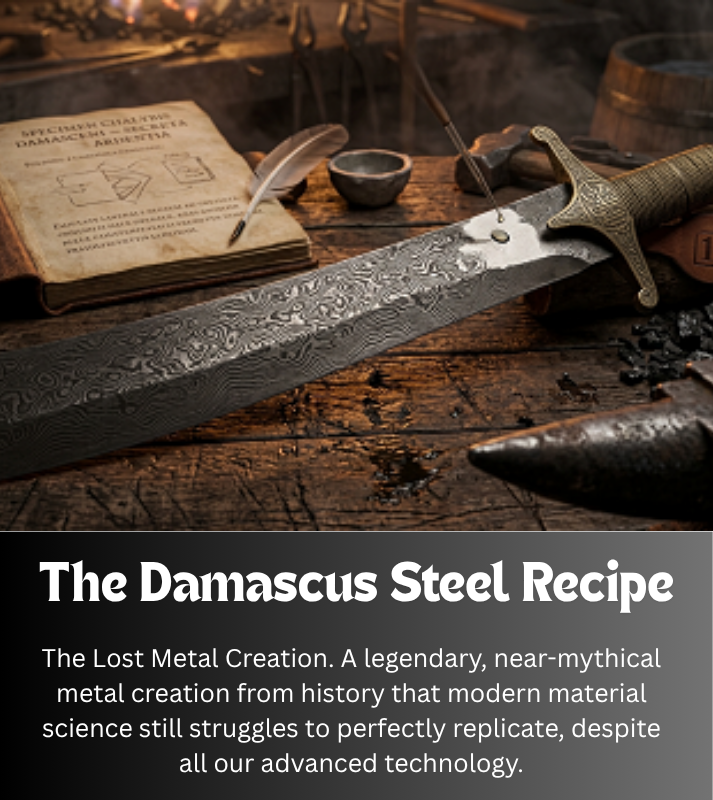
Centuries ago, rumors spread across the battlefields of Europe and the Middle East about an almost magical metal. It was said that weapons forged from this steel could cleave a floating silk handkerchief in mid-air, bend completely out of shape without snapping, and shatter ordinary iron swords with a single blow. This legendary material was Damascus Steel. Instantly recognizable by its swirling, watery patterns that mimic flowing rivers, it remains one of the rarest 1 in million creations in human history. But its greatest wonder isn't just how it performed—it’s the fact that today, despite all of our advanced modern technology, the exact authentic recipe is completely lost to time.
The Ancient Legend: A Masterclass in Metallurgy
Originating around the 3rd to 5th centuries, these blades were forged primarily in the Middle East using specialized ingots of "Wootz steel" imported from India. The ancient blacksmiths who worked with this raw material weren't just pounding hot metal; they were inadvertently practicing high-level nanotechnology.
The Unique Pattern: The characteristic wavy lines on a Damascus blade aren't just painted or etched onto the surface. The pattern runs entirely through the metal, created by bands of iron carbides forming during a highly specific, slow-cooling crystallization process.
Microscopic Power: Modern electron microscopes analyzing surviving museum pieces have revealed something mind-boggling: authentic Damascus steel contains microscopic carbon nanotubes and nanowires.
The Perfect Balance: This unique internal structure gave the blades a combination of properties thought impossible at the time—unbelievable hardness to keep a razor-sharp edge, paired with extreme flexibility to absorb high impact.
The Great Mystery: How Was the Recipe Lost?
The Great Mystery: How Was the Recipe Lost?
By the mid-18th century, production of these legendary weapons ground to a complete halt. The master blacksmiths passed down their techniques strictly through word-of-mouth and secret apprenticeships, meaning nothing was ever formally written down. When production stopped, the exact formula vanished from the face of the Earth. Several factors likely caused this historical tragedy:
Depleted Raw Materials: The specific mines in India that produced the unique Wootz steel ore—which contained exact trace amounts of elements like tungsten and vanadium—finally ran dry. Without the correct chemical blueprint in the raw iron, the process failed.
Broken Master-Apprentice Chains: Long periods of peace or shifts in trade routes meant fewer blades were ordered, breaking the generation-to-generation transfer of secrets.
The Rise of Firearms: As gunpowder changed the face of global warfare, the demand for hyper-elite, hand-forged swords plummeted, forcing blacksmiths to abandon the craft.
The Modern Search for the Lost Creation:
Today, modern bladesmiths sell beautiful knives labeled "Damascus steel," but these are almost always made using pattern-welding—acid-etching and folding together two different types of modern steel. While visually stunning, it is a completely different process from the ancient chemical crystallization of Wootz steel. Scientists and metallurgists have spent decades trying to reverse-engineer surviving artifacts, but the exact combination of heat manipulation, specific ore impurities, and folding techniques remains a puzzle we haven't perfectly solved.
A True 1 in Million Creation:
Damascus Steel serves as a humbling reminder that our ancestors possessed brilliant, highly sophisticated engineering secrets that modern computers still struggle to replicate. It sits proudly in the 1 in million creations archive as a beautiful masterpiece born from fire, science, and absolute mystery.
Discover the extraordinary and unique stories.
Inspire
© 2026. All rights reserved.