
Derek Paravicini
The 1 in million Mind Who Speaks Through the Piano
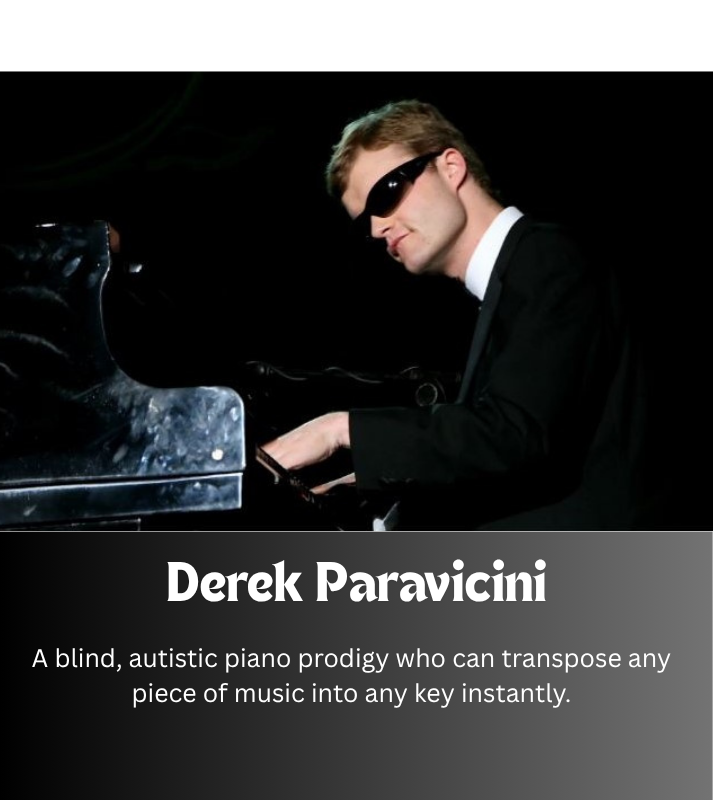
While most people use words to communicate, Derek Paravicini uses 88 keys. Born profoundly premature, blind, and with severe autism, Derek has become one of the most celebrated musical savants in history. His story is a powerful testament to the extraordinary potential of the human brain—a true 1 in million example of how music can transcend any barrier.
The Human iPod
Derek’s musical memory is nothing short of legendary. Dubbed "The Human iPod," he has a repertoire of tens of thousands of pieces stored in his mind. He doesn’t need sheet music; he learns incredibly complex compositions simply by hearing them once.
Perfect Pitch: Derek possesses an acute sense of perfect pitch that allows him to identify every single note in a 20-to-40-note chord.
Total Recall: Whether it’s a jazz standard, a pop hit, or a classical concerto, Derek can reproduce the music with flawless technical precision and emotional depth after a single listen.
A Master of Improvisation
What makes Derek a 1 in million mind isn't just his memory—it's his creativity. He doesn't just "replay" music; he reimagines it.
During live performances, he often takes "impossible" requests from the audience. He might be asked to play "Happy Birthday" in the style of Mozart, or a Beatles song in a minor key with a ragtime twist. Without a moment's hesitation, he seamlessly blends genres and keys, creating entirely new arrangements on the fly.
The Human iPod, A Master of Improvisation
From a "Year of Wonders" to Global Icon
Derek’s journey began at age two when he first sat at a piano. By age nine, he was performing with the Royal Philharmonic Pops Orchestra. Since then, he has:
Performed at Buckingham Palace and Downing Street.
Shared his story through a viral TED Talk translated into 26 languages.
Inspired the biography In the Key of Genius, detailing his life and his long-standing partnership with his mentor, Adam Ockelford.
For Derek, the world can often be a confusing place, but at the piano, everything makes sense. He reminds us that genius doesn't always look the same and that some of the most beautiful "languages" in the world don't require a single word.
Discover the extraordinary and unique stories.
Inspire
© 2026. All rights reserved.