
Gottfried Leibniz
The 1 in million Polymath of the Enlightenment
A Mind Without Borders
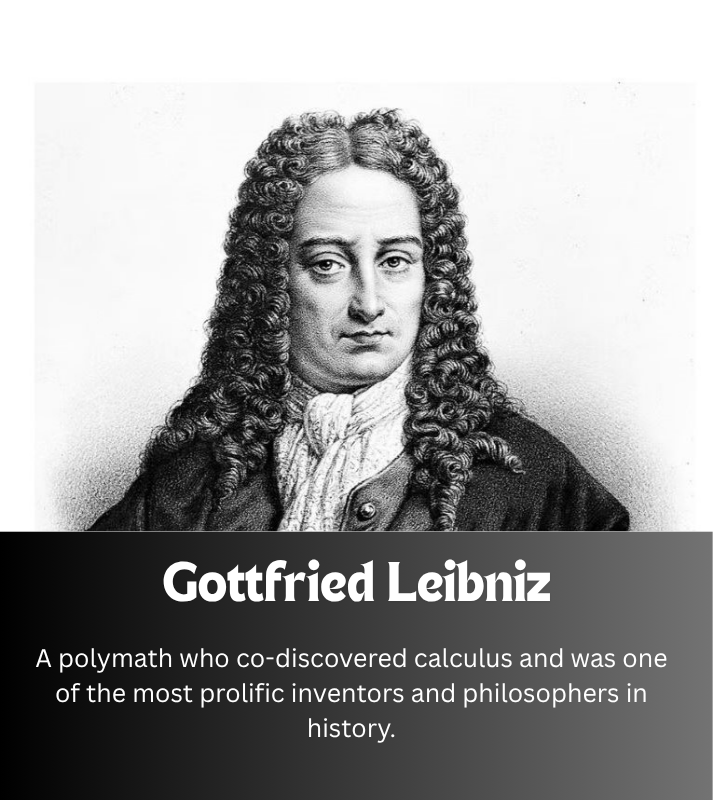
Born in 1646 in Leipzig, Leibniz was largely self-taught in his father’s library, reading Greek and Latin classics by the age of twelve. He didn't just learn history; he sought to influence it. Throughout his life, he served as a high-level advisor to royalty, traveling across Europe to bridge political and religious divides, all while making world-altering scientific breakthroughs in his spare time.
The Architect of the Digital Age
Perhaps his most prophetic achievement was the perfection of the binary number system.
The 0 and 1 Revolution: Long before the first computer was built, Leibniz realized that any mathematical logic could be represented by 0s and 1s.
The Foundation of Computing: Every smartphone, laptop, and digital system used today operates on the binary logic that Leibniz championed more than 300 years ago.
The Calculus Controversy
Leibniz is famously known for independently inventing Calculus around the same time as Isaac Newton. While history debated who was first, it was Leibniz’s elegant notation—such as the integral sign ($\int$) and the $d$ for differentials—that became the global standard. If you study math today, you are writing in the "language" of Leibniz.
Philosophy and "The Best of All Possible Worlds"
As a philosopher, Leibniz tackled the deepest questions of existence. He famously proposed that we live in the "best of all possible worlds," arguing that a supreme intelligence would have chosen a reality that balances variety and simplicity. He also developed the theory of Monads—elementary particles of reality—which some modern physicists view as a precursor to quantum theory.
The Architect of the Digital Age, Born in 1646 in Leipzig
Three Reasons Leibniz Was a 1 in million Mind
Universal Language: He dreamed of a Characteristica Universalis, a universal formal language that would allow people to settle any argument through calculation.
Mechanical Innovation: He invented the "Stepped Reckoner," the first calculator capable of performing all four arithmetic operations (addition, subtraction, multiplication, and division).
Interdisciplinary Mastery: He made significant contributions to law, geology, linguistics, and library science, proving that a single mind could contain the knowledge of an entire era.
Discover the extraordinary and unique stories.
Inspire
© 2026. All rights reserved.