
The Kerguelen Hourglass Waves
Cross Seas
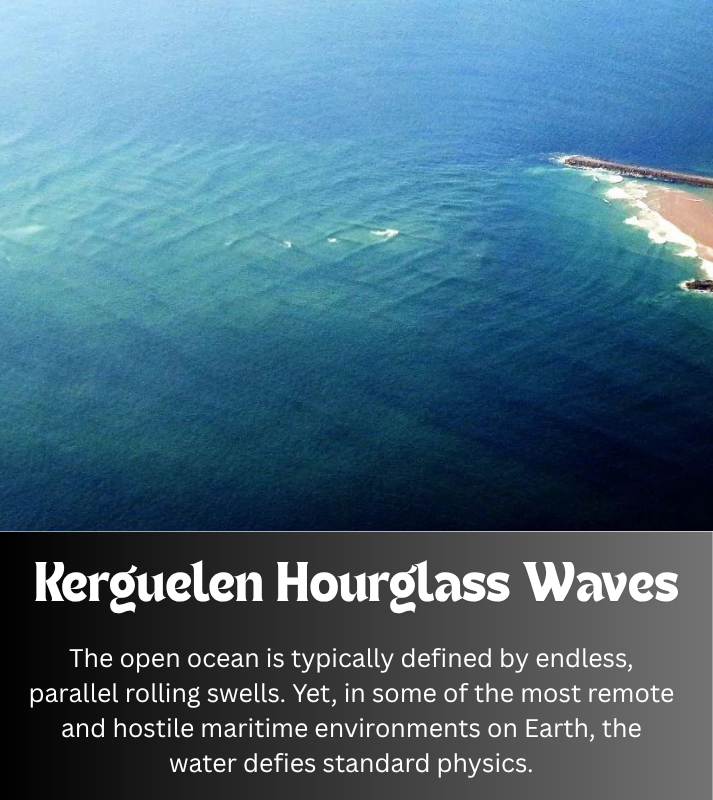
The open ocean is typically defined by endless, parallel rolling swells. Yet, in some of the most remote and hostile maritime environments on Earth, the water defies standard physics. Instead of moving in a single unified direction, the ocean fractures into a surreal, geometric grid—resembling a massive chessboard or a series of interlocking hourglass shapes stitched across the surface of the sea.
This breathtaking and terrifying natural phenomenon is known as a Cross Sea, and its most dramatic, powerful iteration occurs as The Kerguelen Hourglass Waves. It is a spectacular 1 in million marvel of fluid dynamics.
What is a Cross Sea?
A cross sea occurs when two independent wave systems—generated by separate weather fronts or storms that may be thousands of kilometers apart—travel across the ocean and collide at sharp, perpendicular angles.
Rather than merging together or flattening one another out, the two conflicting swells pass directly through each other. When they intersect at a precise $90^\circ$ angle, the peaks and troughs of the opposing waves form a temporary, shifting matrix of perfect squares and hourglass patterns on the surface.
Why the Kerguelen Islands Produce the Ultimate "1 in million" Grid?
While minor cross seas can occasionally be seen near coastal tourist spots like Île de Ré in France, the Kerguelen Hourglass Waves are an entirely different beast. Located in the southern Indian Ocean, the French Kerguelen Islands are among the most isolated places on the planet, heavily subjected to the infamous "Furious Fifties" winds.
The region creates a perfect storm for the world's most severe cross seas due to three rare factors:
The Roaring Antarctic Swells: Unchecked by large landmasses, immense, deep-water swells travel constantly around the Antarctic circle, packing monumental kinetic energy.
Sudden Sub-Polar Front Shifts: Weather systems in this part of the world change with violent speed. A fierce wind can suddenly pivot a full $90^\circ$, instantly generating a brand-new, aggressive "wind sea" directly across the path of the older, massive rolling swells.
The Hourglass Peak: Because both intersecting wave systems possess deep-ocean power, the points where the crests slam into each other don't just form flat squares. They thrust upward into sharp, pyramid-like crests that pinch in the middle from opposing lateral pressures, creating a mesmerizing "hourglass" geometry before crashing down.
The Kerguelen Hourglass Waves
The Mesmerizing Danger Behind the Beauty:
From an airplane or a high cliff, the hourglass grid looks like a beautifully peaceful, engineered work of art. But below the surface, it is one of the deadliest traps a mariner or swimmer can face.
The Physics of the Trap:
When a vessel navigates normal rough seas, the captain steers the bow directly perpendicular into the oncoming surf to crest safely over the waves. In a Kerguelen cross sea, this becomes completely impossible. Steering directly into one set of waves forces the hull of the boat to run parallel to the second set of waves, exposing the vulnerable side of the ship to broadside impacts. The competing lateral forces create violent, unpredictable undercurrents and massive "white walls" of water that can reach over 10 feet high, capable of easily capsizing small vessels and severely destabilizing large cargo ships.
A Fleet-Footed Phantom:
Part of what makes the Kerguelen Hourglass Waves a true 1 in million sight is their temporary, elusive nature. They can materialize out of nowhere as a wind front shifts, lock the ocean into a flawless geometric grid for a few fleeting minutes, and then dissolve back into chaotic whitecap foam as the energies blend or dissipate. It stands as a stark, beautiful reminder that even in the chaotic wilderness of the southern seas, nature can briefly organize itself into perfect, mathematical symmetry.
Quick Facts for Your Reference:
Scientific Formula: Mathematicians use the Kadomtsev–Petviashvili equation to map out and explain the nonlinear mechanics of these intersecting wave fronts.
Location: The open, treacherous Southern Ocean surrounding the Kerguelen Archipelago.
The Golden Maritime Rule: If you are ever at sea or on a coastline and witness the water forming a grid pattern, do not enter—it is a universal warning sign of highly hazardous rip currents and unstable waters below.
Discover more mind-blowing natural anomalies and extraordinary wonders of the world in our curated collection at 1inmillion.com.
Discover the extraordinary and unique stories.
Inspire
© 2026. All rights reserved.