
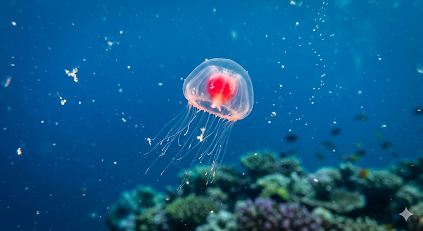
The Immortal Jellyfish (Turritopsis dohrnii)
Introduction: The Creature That Outsmarted Death In the deep, quiet corners of the world’s oceans floats a tiny creature no larger than a pinky nail. To the casual observer, it looks like a delicate, translucent bell drifting aimlessly with the currents. But this tiny organism possesses a superpower that has completely shattered our understanding of biology. Meet Turritopsis dohrnii—the Immortal Jellyfish. While every other creature on Earth faces the inevitable march of time, this jellyfish has found a way to hit the reset button. It is a true 1 in million creation of nature, holding the key to a biological loophole that allows it to escape death entirely. The Ultimate Survival Hack: Cellular Transdifferentiation Most jellyfish follow a straightforward life path: they start as a microscopic larva, anchor themselves to the ocean floor as a polyp (like a tiny sea anemone), and eventually bloom into a free-swimming adult jellyfish (called a medusa). When a normal jellyfish reaches the end of this cycle, it reproduces and dies. But Turritopsis dohrnii plays by a different set of rules. When the immortal jellyfish faces an existential threat—such as physical trauma, starvation, an abrupt change in water temperature, or simply the onset of old age—it doesn't die. Instead, it triggers a rare biological process called transdifferentiation. Here is how its mind-blowing survival process works: The Collapse: The adult jellyfish absorbs its own tentacles and shrinks its bell-shaped body into a shapeless blob. Cellular Shape-Shifting: Its existing, specialized adult cells (like muscle or nerve cells) undergo a radical transformation. They actively strip away their current identity and revert back into primitive, unspecialized stem cells. The Rewind: This blob anchors itself back to the seafloor and morphs directly back into a youthful polyp colony. 🔄 The Butterfly Analogy To put this into perspective, imagine a beautiful adult butterfly flying through the sky. If a bird attacks it or food becomes scarce, the butterfly simply drops to the ground, melts its wings away, turns back into a caterpillar, and emerges as a youth all over again. Biologically Immortal, But Not Invincible Because this transformation can be repeated an infinite number of times, Turritopsis dohrnii is considered biologically immortal. Barring external forces, it could theoretically live forever. However, being biologically immortal does not mean it cannot be killed. Because they are tiny and fragile, vast numbers of immortal jellyfish are eaten by predators like fish and sea turtles while drifting in the ocean. Others succumb to severe diseases while in their free-swimming medusa stage. The trick is that if they can manage to find a quiet spot on the ocean floor before being completely consumed, the rewind process begins. Why Scientists Are Obsessed With It Geneticists and medical researchers are deeply studying the DNA of Turritopsis dohrnii. By mapping its genome, scientists hope to unlock the exact genetic switches that control cellular rejuvenation. If we can figure out how this 1 in million organism perfectly programs its cells to repair, reverse, and rebuild themselves without causing tumors or decay, it could revolutionize human medicine—potentially unlocking new treatments for age-related illnesses, cellular degeneration, and tissue regeneration. A True 1 in Million Wonder The Immortal Jellyfish challenges everything we think we know about the finality of life. It serves as a stunning reminder that nature's genius is often hidden in its smallest creations, floating quietly in the dark, writing its own rules of time.
WONDERS OF NATURE
5/30/20261 min read
Discover the extraordinary and unique stories.
Inspire
© 2026. All rights reserved.