
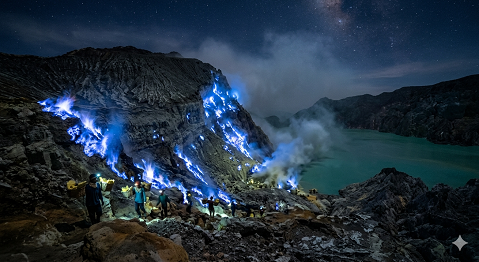
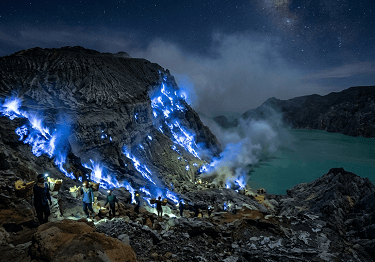
The Kawah Ijen Volcano: The Volcano That Spits Neon Light
When you think of a volcanic eruption, your mind immediately paints a specific picture: blinding rivers of bright orange, incandescent red, and yellow lava creeping down a dark mountain. It is a terrifyingly beautiful sight that has remained consistent for millions of years.But tucked away in East Java, Indonesia, there is a geological anomaly that completely shatters this rule.Meet Kawah Ijen—the volcano that glows with an otherworldly, electric neon blue light in the dark. It is a breathtaking 1 in million creation of nature that looks less like planet Earth and more like a glowing landscape from a distant alien world.The Science: Why is the Fire Blue?A common misconception is that Kawah Ijen actually produces blue lava. In reality, if you were to visit the volcano during the bright daylight hours, the molten rock trickling down the slopes looks exactly like the red-hot liquid rock found anywhere else on earth.The magic happens purely at night, and the secret lies in a fierce chemical reaction:High-Pressure Gas Leaks: Kawah Ijen sits on top of massive subterranean chambers that leak extreme quantities of highly concentrated sulfuric gases.The Ignition Point: These volcanic gases are pushed out of cracks in the rock face at hyper-high pressures and intense temperatures exceeding $600^\circ\text{C}$.The Chemical Flare: The moment these super-heated sulfuric gases make contact with the oxygen-rich outside air, they instantly ignite. When sulfur burns, it combusts with a brilliant, intense, electric-blue flame.The flames shoot up to 16 feet into the air. Because some of the gas condenses into a liquid state while still burning, it flows down the side of the mountain—creating the stunning visual illusion of glowing, liquid-blue neon lava pouring through the dark.The World's Most Acidic LakeThe blue fire isn't the only '1 in million' feature hidden inside Kawah Ijen's crater. Right next to the burning sulfur fields sits a massive, data-defying crater lake.Spanning roughly three-quarters of a mile wide, the Kawah Ijen crater lake is highly recognized as the largest highly acidic crater lake in the entire world.Filled with a vibrant, turquoise-green water, the lake’s extreme color is caused by a potent cocktail of dissolved metals and high concentrations of sulfuric and hydrochloric acid. The water inside this lake features a pH level hovering near 0.5, making it roughly as acidic as pure battery acid or stomach acid. Anything metallic or organic that falls into its waters is dissolved in a matter of days.The Hardest Job on Earth: The Miners of IjenWhile tourists travel from all over the globe to witness the neon glow, Kawah Ijen is also a grueling, real-world workplace.Every single night, local sulfur miners descend directly into the steep, treacherous active crater. Surrounded by shifting wind patterns and choking, toxic clouds of sulfur dioxide gas—often working with only a damp cloth wrapped around their mouths for protection—they break cooled, solidified bright-yellow sulfur blocks by hand.They load these heavy mineral chunks into bamboo baskets and carry loads weighing between 150 to 200 pounds out of the steep crater rocky paths. It is widely considered one of the most physically demanding and hazardous jobs on the planet.A True 1 in Million Natural WonderKawah Ijen is a magnificent reminder that nature still holds secrets that can completely disrupt our normal expectations of the physical world. It stands proudly in our archive as a masterpiece of geology, chemistry, and absolute visual wonder.
WONDERS OF NATURE
5/30/20261 min read
Discover the extraordinary and unique stories.
Inspire
© 2026. All rights reserved.