
Vantablack
The Material That Swallows Light
Introduction: A Physical Black Hole on a Desk:
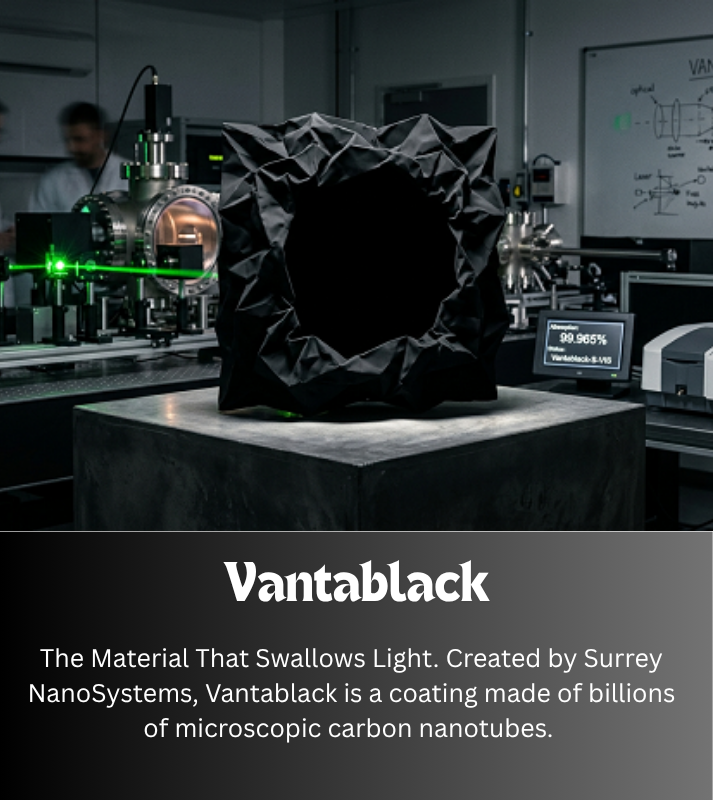
Imagine looking at an object and seeing absolutely nothing. No texture, no contours, no shape, and no shadows. Your eyes aren’t failing you; your brain is simply experiencing Vantablack—the closest thing to a physical black hole you can touch on Earth.
Invented by the British company Surrey NanoSystems, Vantablack isn’t a paint, a pigment, or a fabric. It is a complex nanotechnology matrix that stands as a true 1 in million creation. It doesn't just block light; it completely consumes it.
The Science: How Do You Trap Light?
To understand Vantablack, you have to look past what the human eye can see. The material is grown in a specialized laboratory using a process called chemical vapor deposition.
The Nanotube Forest: Vantablack is composed of a dense "forest" of microscopic carbon nanotubes.
10,000x Thinner Than Hair: Each individual nanotube is roughly $20\text{ nm}$ in diameter (about 10,000 times thinner than a human hair) and around $20\text{ }\mu\text{m}$ to $30\text{ }\mu\text{m}$ high.
The Trapping Mechanism: When light particles (photons) hit the surface of Vantablack, they don't bounce off like they do on normal dark surfaces. Instead, they fall between the gaps of the vertical nanotubes, bouncing around endlessly within the structural maze until they are entirely absorbed and converted into thermal energy.
Invented by the British company Surrey NanoSystems
📊 The Ultimate Light Vacuum:
Normal black paint or charcoal absorbs roughly 95% to 98% of visible light. Vantablack absorbs a staggering 99.965% of all visible light. The remaining 0.035% is so minuscule that the human eye cannot detect it.
Shattering Human Depth Perception:
The visual effect of Vantablack is deeply unsettling to experience in person.Because our eyes rely on reflected light and shadows to perceive depth, curves, and texture, removing 99.96% of reflected light breaks our visual processing. If you coat a highly crinkled sheet of aluminum foil in Vantablack, the crinkles completely vanish to the viewer. It transforms into a flat, infinite, two-dimensional void.
Even if a high-powered laser pointer is aimed directly at the material, the bright beam completely disappears the moment it touches the surface. There is no reflection to travel back to your eyes.
Why Was It Created? (Beyond the Hype)
While Vantablack makes for mind-blowing optical illusions, it was engineered to solve some of the most complex problems in modern science and space exploration:
Next-Generation Space Telescopes: Stray starlight is the enemy of deep-space cameras. Coating the inside of telescope housings with Vantablack prevents unwanted light from bouncing into the sensors, allowing scientists to photograph the faintest stars and most distant galaxies in the universe.
Thermal Camouflage: Because it converts light directly into minimal heat so efficiently, it has unique applications in advanced calibration systems for infrared cameras and defense tech.
Art and Design: The material caused a massive stir in the art world when contemporary artist Anish Kapoor secured exclusive artistic rights to use the original Vantablack formulation, sparking fierce debates across the creative community.
Discover the extraordinary and unique stories.
Inspire
© 2026. All rights reserved.